Waterfowl
How Waterfowl Seasons Are Set
Migratory birds are a federal matter, flyway councils sit in the middle, and each state chooses inside the frame it is given. Understanding that chain beats memorizing a date that changes every year.
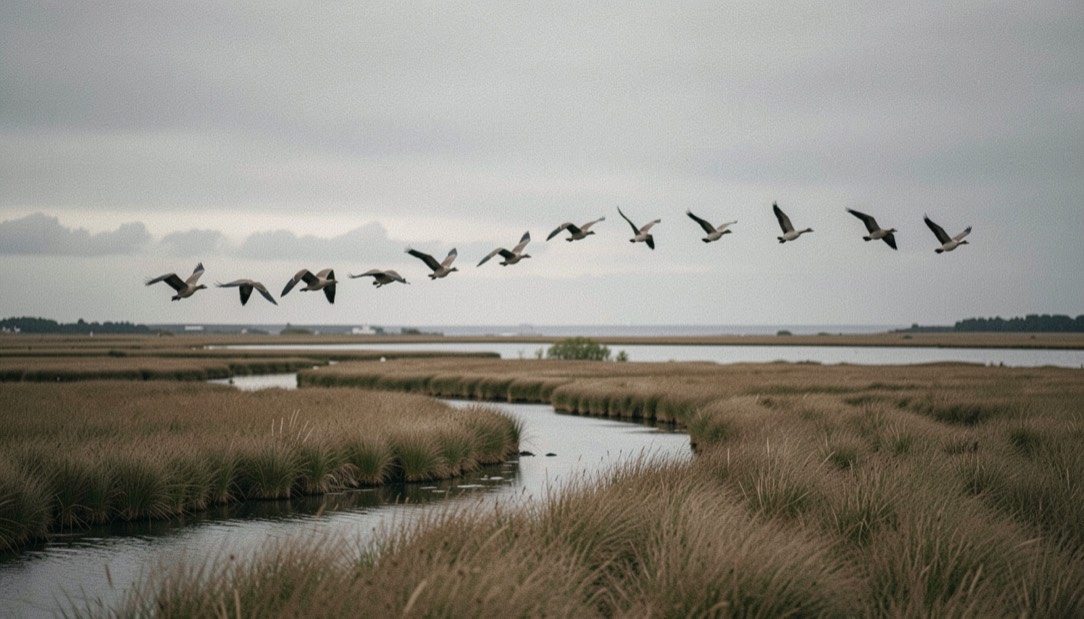
Every year the same question circulates in the same form: when does the season open. It is the wrong question to build a page on, because the answer expires in twelve months and a page that carries it goes on being read long after it has stopped being true. The question worth answering once is the other one: who decides, in what order, and where can a reader look it up for themselves every year without asking anybody.
No date of any kind appears below, and no duration and no quota. The federal and state publications behind this mechanism have not been read at the source for this site, so what follows describes the articulation of the system rather than any figure produced by it, and it says where to go to read the current numbers. The reading status of every document that feeds this publication is listed in sources and method.
Migratory birds are a federal matter
The first thing to understand is that waterfowl are not, at the starting point, a state subject at all. Birds that migrate cross state lines and international borders on a schedule that has nothing to do with jurisdictions, and the legal framework built around them reflects that: they are treated at federal level first, and the states work inside what that framework allows.
This is why the structure of the rules can look upside down to anyone used to other kinds of hunting. For a resident species, a state can largely decide what it wants. For a migratory one it cannot, because the same population will be somewhere else in a month, and a decision made in one place is a decision taken away from everybody further down the route.
The practical consequence for a reader is that there are always two layers to check and never one. A state publication tells you what your state chose. It does not tell you what the frame was, and both matter if you are trying to understand why something changed.
What a flyway council actually does
Between the federal level and the individual state sits a regional layer organized around the migration routes themselves. The country is divided into flyways, and the states along each route work together on the questions that only make sense at the scale of the whole route: what the population looks like this year, what the habitat did, what the breeding season produced, and what the states along the route can reasonably ask for.
The value of that layer is that it puts the decision at the same scale as the animal. A single state looking at its own water sees a fraction of a population that spends most of the year somewhere else. The route as a whole is the unit that actually matches the bird, and the regional structure exists so that recommendations are made at that scale before anything is set.
What that layer does not do is issue the rules a hunter obeys. It informs the frame. The frame constrains the state. The state publishes what applies to you.
| Level | What it handles | What it produces | Where it sits in the sequence |
|---|---|---|---|
| Federal | Migratory birds as a whole, across every state they pass through. | The frame inside which states may choose. | First. Nothing below it can exceed it. |
| Flyway, meaning the regional structure along a migration route | Population, habitat and productivity at the scale of the route. | Recommendations and a common view of the year. | Between the frame and the state. |
| State wildlife agency | The choices left open inside the frame, applied to its own geography and its own zones. | The rules a hunter actually reads and obeys. | Last, and the only publication that binds you. |
| State agency, separately | Dog training outside the hunting season, and what may be done with birds and on which ground. | A separate set of rules from the season rules. | Independent of the federal frame, and frequently overlooked. |
| Landowner | Access, permission and what may happen on the ground itself. | Nothing legal about seasons, and everything about whether you can be there. | Always, and before any of the above matters in practice. |
Where the state makes its choices
Inside the frame it is given, a state has real decisions to make, and they are the ones that produce the differences a hunter notices. Where the internal zone boundaries run, so that a coastal marsh and an inland lake are not treated as the same water. How the available days are distributed. Which parts of the state open when, given that a migration does not arrive everywhere at once.
That is why two neighboring states do not open on the same day, and why the answer to a question about your own season is always a state publication rather than a general article. It is also why nothing on this page will ever tell you what your season is: only your state agency can, and it republishes the answer every year.
Why the Atlantic Flyway looks the way it does
The eastern seaboard states, Maine among them, sit on the Atlantic route. The geography does most of the explaining. The route runs along a coast rather than through a continental interior, which puts a large amount of tidal and estuarine habitat into it, and it is long in the north to south direction, so the same population arrives in very different places at very different points in its movement.
For a dog and a handler in the Northeast, the consequence is a season that runs into genuinely cold weather and that overlaps with the part of the year when the training calendar has already handed the dog back. The shape of that working year is described in how a trial year is built, and what the water costs a dog in those months is set out in cold water work.
Reading the rules for your own season, every year
- Start at your state wildlife agency, not at a general article. It is the only publication that binds you.
- Find your zone before you read a date. Zones are how a state applies one frame to several kinds of water.
- Read the current year's document rather than last year's, and check the year printed on it.
- Read the dog training rules separately. They are a different set of rules, published in a different place, and they govern the other ten months.
- Check what applies to the specific water you use, because coastal, inland and impounded water are frequently treated differently.
- Settle access with the landowner before any of the above becomes relevant.
- Re read all of it every year. The frame changes, the state's choices change inside it, and the habit of assuming is how people get caught.
What this page will never carry
No current season dates, no bag figures, no duration and no zone boundaries. All of those change annually, all of them are published by the people responsible for them, and a copy of them here would be wrong within a year while continuing to rank. The mechanism above does not change annually, which is exactly why it is what gets written down.
The same reasoning governs the training side. Rules on what may be done with a dog outside the season are set by the state and read from the state, never inferred from what people do on the ground. That question is treated alongside access and permission in training ground and access, and what the season means for the dog itself is described in the dog in the blind.
Common mistakes
- Reading a general article for your dates. Only the state agency publishes what binds you, and it republishes it every year.
- Assuming a neighboring state's season. Two states inside the same frame make different choices, and the border is real.
- Reading a date without reading a zone. In most states the zone is the first thing that decides the answer.
- Confusing the season rules with the dog training rules. They are separate documents governing separate activities.
- Treating last year's document as this year's. The year printed on the cover is the first thing to check.
- Believing that a legal season answers the access question. Permission is a separate conversation and it comes first.