Grounds & Seasons · Grounds
How a Retriever Trial Year Is Built
The working year turns on the water, not on the calendar. It starts when ice leaves the ponds and it hands the dog back to the hunting season every autumn.
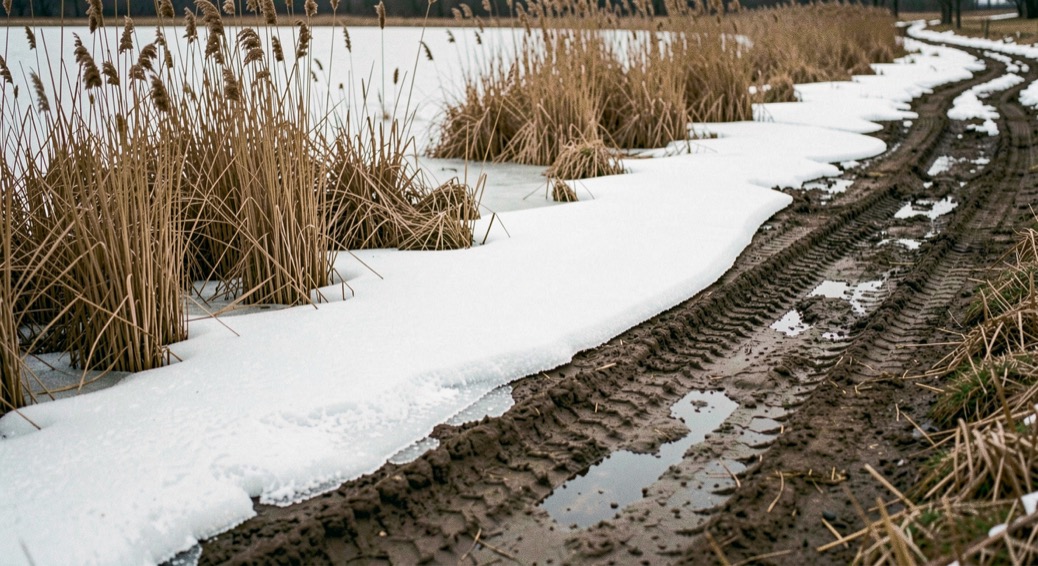
The working year of a retriever in the Northeast does not begin in January and it does not follow the civil calendar at any point. It follows the water. Ice decides when training can restart, heat and cover decide what the middle of the year permits, the hunting season takes the dog back in the fall, and the cold months are spent building the things that do not need water at all.
No dates appear on this page, and no places and no entries. What is described is the shape of a year: which conditions arrive in which order, what each of them makes possible, and what each of them takes away. That shape is stable, which is why it is worth writing down, while a calendar would be wrong in twelve months.
The year starts at ice out, not in January
Ice out is the event that actually opens the working year in the north. Until the ponds are clear there is no water work at all, and water work is the constraint that everything else in this sport is organized around. Land work continues through the cold months, but a dog cannot be prepared for a level that requires water retrieves on land, and the levels that matter all require water.
The date of ice out is not a date. It varies by a matter of weeks from one year to the next and by more than that between a shallow farm pond and a deep lake ten miles away. A handler who plans a season against the calendar will be wrong at least half the time; a handler who plans it against the water will be right, because the water is the thing the dog is going into.
What follows the ice is a difficult period rather than an easy one. The water is open and it is at its coldest of the usable year, which means the first sessions are short by necessity and are aimed at rebuilding condition rather than at testing anything. What that costs the dog and how to read it is set out in cold water work.
Spring: the water opens and the circuit follows
Spring is the busiest part of the organized year for a simple reason: the water is open, the cover is still low, and the ground is visible in a way it will not be again until after the first frosts. Marks can be set at real distance across ground where the dog can actually be seen working, which is exactly what judges and handlers both want.
It is also the part of the year with the most competition for ground. Fields are wet, farmers are working them, and the same short window is wanted by everyone at once. Ground that is available in spring is worth a great deal more than ground that is available in August, and that fact shapes how people arrange their seasons far more than any published schedule does.
The other characteristic of spring is that dogs are not yet fit. A dog coming out of a winter of land work has the skills and not the condition, and the honest version of a spring plan accounts for that instead of assuming a dog picks up where it left off in the fall.
Summer: heat, cover and the season of tests
By high summer the constraint has reversed completely. The water is warm and easy, and the limiting factor is the dog rather than the conditions: heat becomes the risk, cover has grown to the point where a bumper disappears entirely, and sessions have to be moved to the ends of the day.
Cover is the underrated part of that. Grown cover changes what a mark asks: the dog can no longer see the fall area from the line, scent behaves differently in still warm air, and a mark that was fair in May is a hunt in July on the same ground. That is not a problem to be solved, it is a different exercise, and treating it as the same exercise is how handlers conclude their dog has gone backwards.
It is also the part of the year when the scored programs are most active, since a test can be run on ground that a trial would find too enclosed, and warm water suits levels that ask for water retrieves without asking for enormous distance.
| Condition | What opens | What closes | What the dog needs |
|---|---|---|---|
| Ice out and early open water | Water work resumes. Ground is visible and cover is low. | Long sessions. The water is at its coldest of the usable year. | Condition rebuilt gradually, and short decisive sessions. |
| Spring, water open and cover low | Long marks across ground where the dog can be seen working. The busiest part of the organized year. | Free access to fields, which are wet and in use. | Fitness, and ground secured before everyone else wants it. |
| Summer, warm water and heavy cover | Easy water, and the scored programs at their most active. | Long marks across open ground. Cover has closed the sightlines. | Work at the ends of the day, and respect for heat as the real risk. |
| Fall, first frosts and the hunting season | The dog goes back to the work all of this imitates. | Most organized training. The dog is busy elsewhere. | A different set of skills: waiting, decoys, and the surface it works from. |
| Winter, hard ground and closed water | Obedience, handling, whistle work, condition, and everything that does not need water. | Water retrieves entirely, and with them any preparation specific to them. | Patience, and a plan that points at what the spring will ask. |
Fall: the hunting season takes the dog back
The autumn is where the whole structure reveals what it is for. The organized programs exist to reproduce, under rules, a day of waterfowl hunting, and in the fall the dog goes and does the original thing instead of the copy. That is the argument for the shape of the year rather than an inconvenience in it.
The skills the season asks for are not the skills the summer built, which is worth planning for rather than discovering. Hours of stillness, marking through decoys, working from whatever surface the hunt provides and dealing with birds that do not fall where anyone intended: all of that is described in the dog in the blind. The mechanism that decides when the season happens at all, without any dates, is in how seasons are set.
Winter: the months that build next spring
Winter looks empty and is not. It is where obedience, whistle work, casting on land, condition and the long unglamorous repairs get done, and a handler who uses it arrives at ice out with a dog that only needs water rather than a dog that needs everything. It is also the natural moment for the paperwork side of things, because screening sessions and record keeping fit into the part of the year when nothing else is competing for the day. What those documents mean is set out in CAER eye screening.
The other winter job is securing ground for the spring, which is a conversation and not a search. Criteria for judging a field, and the access question that eliminates half the candidates, are set out in what makes good training ground. And the levels that the whole year points at, with what each one asks, are laid out in AKC field trials explained.
Planning a year on this shape
- Watch the water rather than the date. Ice out moves by weeks and it is the event that opens the year.
- Treat the first open water sessions as condition work, short and few, whatever the dog could do last autumn.
- Set the long marks while the cover is still low, because that window closes and does not reopen until the frosts.
- Move sessions to the ends of the day once heat, and not cold, becomes the limiting factor.
- Expect the same field to ask a different question in July than it did in May, and set the mark for the cover in front of you.
- Give the autumn to the hunting the whole discipline imitates, and prepare the skills it asks for before it starts.
- Use the closed months for obedience, handling, condition and paperwork, then arrive at ice out needing only water.
- Have the access conversation in the quiet part of the year, not in the week you want the field.
Common mistakes
- Planning a season against the calendar. Ice out moves by weeks, and the water is what the dog is going into.
- Assuming a dog resumes where it stopped. Skills survive a winter; condition does not.
- Reading a summer mark as the same test as a spring mark. Grown cover has changed the exercise, not the dog.
- Treating the hunting season as an interruption of training. It is the thing training imitates.
- Wasting the winter. It is where handling, obedience and condition are cheapest to build.
- Looking for ground in April. Access is a conversation held months earlier, in the quiet part of the year.