Breeds & Health
CAER Eye Screening for Retrievers
The eye examination is the clearance that expires. A certificate with an old date on it is not a current result, and reading it as one is the most common mistake made with a litter paperwork.
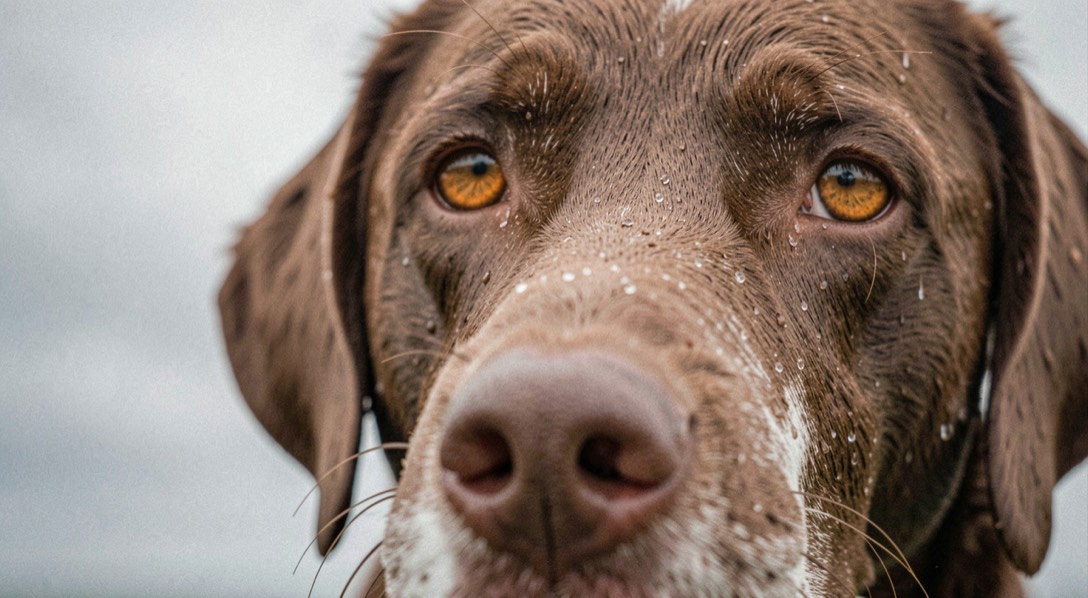
Among the documents that follow a working retriever around, the eye examination is the odd one out. Every other clearance a buyer is shown either describes a permanent piece of anatomy or reads a fixed genetic result. The eye examination describes what an examiner saw on one particular day, and that is why it behaves differently from everything else in the folder.
Nothing on this page is veterinary advice. There is no protocol, no dosage and no diagnosis here, and no individual dog's record is republished. What follows is what the examination is, what it can settle, and what it cannot, so that a reader can tell whether the piece of paper in front of them answers the question they are actually asking. Anything about a particular animal belongs with a veterinarian.
What a CAER examination actually is
A CAER examination is an eye examination performed by a board certified veterinary ophthalmologist, whose findings are recorded on a standard form and submitted to the registry that keeps the records. It is a clinical examination, not a laboratory test: the examiner looks, with instruments, at the structures of the eye, normally with the pupil dilated, and writes down what is present.
The practical shape of it is unremarkable and takes a few minutes per dog once the pupil is dilated. Because the equipment is portable and the examination is short, these examinations are commonly organized as sessions where many dogs are seen in one place on the same day, which is why the phrase eye clinic attaches itself to the subject in the first place.
What matters for anybody reading the resulting certificate is the two words clinical and dated. The examiner is describing a state, and the state has a date on it. That single feature explains everything else on this page.
What the examiner looks at
The examination is a survey of the eye rather than a search for one thing. The examiner works through the structures in order, from the outside inward: the lids and their margins, the surface of the eye and the cornea, the anterior chamber, the iris, the lens, and then the back of the eye, meaning the retina and the optic nerve head, which is the part that requires dilation and the part most people mean when they talk about this examination at all.
Findings are recorded as they are found, and a form can carry observations that are noted without being significant, alongside anything that is. That is why a certificate is a document to read rather than a badge to display, and why the summary line on it is not the whole of it.
| Part of the examination | What is being looked at | What it does not settle |
|---|---|---|
| Lids and lid margins | How the lids sit and close against the surface of the eye. | Anything about how the eye will behave under work, wind and water. |
| Cornea and the surface | Clarity and integrity of the surface of the eye. | Injuries, which happen in cover and are not heritable. |
| Anterior chamber and iris | The front structures of the eye as they are on the day. | Any change that appears later. |
| Lens | Clarity of the lens. | Whether an observation seen today will progress. |
| Retina and optic nerve head | The back of the eye, examined with the pupil dilated. | Genotype. Where a genetic test exists for a condition, the examination does not replace it. |
| The form as a whole | A record of the state of both eyes on a stated date. | The state of the same dog next year, which is why the examination is repeated. |
Why it is repeated, and hips and elbows are not
A structural evaluation of a hip or an elbow is read from radiographs of a mature dog, and the joint it describes is not going to be rebuilt. A genetic test reads a fixed result from a sample, and a genotype does not change. Both of those are issued once and stand.
An eye examination is neither. It is a description of a living structure at a moment, in an organ where several of the conditions that matter appear over time rather than being present from the start. A dog examined and found clear can develop something that was not there to be found. That is not a failure of the examination; it is what a clinical examination is.
The consequence for a buyer is direct and it is the most useful sentence on this page: a certificate with an old date on it is not a current result. How often the examination has to be repeated to remain current is set by the registry that records it, and that periodicity is not printed here, because the registry's own pages have not been read at the source for this site as of September 2, 2026. What can be said without that reading is that the document dates, and that the date is the first thing to look at. The three families of screening and how they differ are set out in retriever health clearances.
Where it sits among the other clearances
The eye examination appears in the recommended screening lists that registries publish per breed, alongside structural evaluations and whichever genetic tests apply. Which screenings a given retriever breed is asked for is a registry question with a published answer, and no such list is attributed to a breed on this site until those pages have been read at the source. Which breeds are eligible for the retriever programs at all is covered in the retriever breeds.
What is worth knowing without that reading is how the pieces relate. Where a genetic test exists for a specific inherited eye condition, the genetic test and the examination answer different questions: one reads a fixed mutation, the other looks at what is actually present in the eye today. Neither replaces the other, and a folder that contains only one of them is answering half the question.
Reading an eye certificate
- Look at the date before anything else. That is the single most informative line on the document.
- Check that the dog named and registered on the form is the dog you are being shown.
- Read the findings, not only the summary. A form can record observations that were noted and judged unremarkable.
- Ask whether the same dog has been examined before, and whether the earlier forms are available.
- Ask for both parents, and ask where the results are recorded rather than accepting a photograph of a form.
- Ask separately about genetic testing for eye conditions, which is a different question with a different answer.
- Take any question about a particular dog's eyes to a veterinarian, who can examine the animal.
Reading a result without over reading it
A current, clear examination says something real: an ophthalmologist looked at this dog on this date and found nothing of concern. It does not say the dog will never develop anything, it does not say the litter is free of inherited eye disease, and it does not replace the genetic testing that exists for specific conditions.
The complementary error is to over read a finding. Not every observation on a form describes a problem, and the document is designed to record what is there rather than to deliver a verdict. Reading it well means asking the examiner's own profession what a line means, rather than a forum or a general article.
Sessions like these usually fall in the quieter part of the working year, between the periods when dogs are actually running, which is the practical reason paperwork tends to get updated in one block rather than continuously. The shape of that year is described in how a trial year is built, and what to do with the whole folder when reading a litter is set out in finding a reputable breeder.
Common mistakes
- Reading an old certificate as a current result. It is the most common error made with litter paperwork, and it is entirely avoidable.
- Treating the examination as a genetic test. It describes what is present, not what is coded.
- Treating a genetic test as a replacement for it. They answer different questions and both belong in the folder.
- Reading only the summary line and ignoring the findings recorded above it.
- Accepting a photograph of a form instead of asking where the result is recorded.
- Assuming a clear result covers the litter. It covers one dog, on one day.
- Interpreting a finding yourself. That is a conversation for a veterinary ophthalmologist, not for a web page.