Breeds & Health
Elbow Screening: Grades, Ages, Registers
How IEWG elbow grades 0 to 3 work, when to screen, how OFA and national registers compare, and what the results mean for breeding choices.
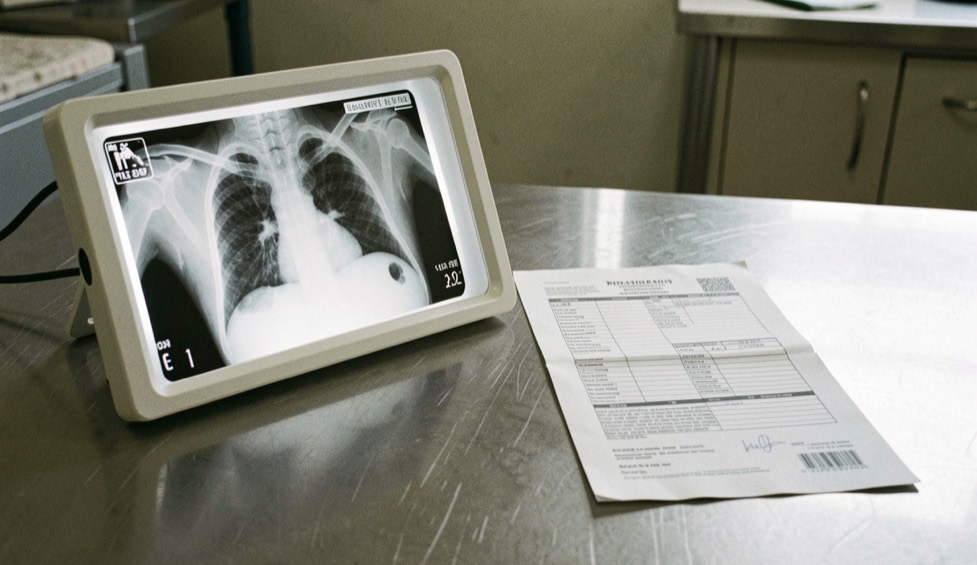
Elbow dysplasia is scored on a scale that runs from 0 to 3, where 0 means no radiographic evidence of the disease and 3 means severe secondary arthrosis. The grade is assigned to each elbow separately, so a dog can be 0:1, 1:1, or any other combination, and the final breeding advice is usually driven by the worse elbow. Screening is normally done from 12 months of age for official certification, though preliminary schemes exist for younger dogs, and the registers of different countries do not all read the same radiograph the same way.
What do the IEWG elbow grades 0 to 3 mean?
The International Elbow Working Group scale is a radiographic severity score, not a diagnosis of a specific lesion. It is built around the secondary osteoarthritis that follows fragmented coronoid process, ununited anconeal process, osteochondritis dissecans of the humeral condyle, or joint incongruity. A reader looks at the joint space, the outline of the coronoid, the anconeal process, and the presence of new bone, then places the elbow in one of four bands.
- Grade 0: no visible arthrosis, no visible primary lesion. The elbow is recorded as normal on the film.
- Grade 1: mild arthrosis, meaning small osteophytes or a slightly irregular joint outline, with no clear primary lesion identified.
- Grade 2: moderate arthrosis, with more obvious new bone, sclerosis, or a visible primary lesion such as a fragmented coronoid.
- Grade 3: severe arthrosis, with large osteophytes, marked joint deformation, and often a clearly visible primary lesion.
The grade describes what the radiograph shows at the time of the examination. It does not describe the dog's pain, gait, or working ability, and a grade 0 dog can still be affected by a lesion that is not yet mineralised enough to see. That is why many programmes combine the score with clinical history, and why a single film is a snapshot rather than a verdict. The full range of lesions, the difference between unilateral and bilateral involvement, and the grading systems used in different countries are set out in the reference material collected at the elbow score database, which is a documentary resource rather than a registry itself.
At what age should a dog be screened for elbow dysplasia?
The short answer is 12 months for an official score, and not before. Most national schemes set a minimum age because the elbow is still growing and the secondary arthrosis that the scale depends on may not yet be visible. Films taken at 6 or 8 months can look clean and still be followed by a grade 2 at two years.
That said, preliminary screening exists. Some programmes allow a first film from 4 to 6 months, usually read as normal or suspect rather than given a full grade, and used to flag obvious problems early. A preliminary result is not a certification and should not be treated as one when planning a litter.
The practical sequence looks like this:
- 4 to 6 months: optional preliminary film, useful if the dog is lame or the breeder wants early information.
- 12 months: earliest age for most official schemes, including the OFA elbow evaluation.
- 18 to 24 months: the age at which many breeders prefer to finalise, because the joint has matured.
- Any age after that: a dog can be scored later, but the result reflects the joint at the time of the film, not at one year.
A dog screened at 12 months and scored 0 is not guaranteed to stay at 0. A dog screened at 12 months and scored 1 may be scored 1 again at three years, or may have progressed. The register records the film, not a promise.
How do national screening registers compare?
Registers differ in three ways: the grading scale, the number of readers, and whether the result is published. The OFA in the United States uses a three category elbow scheme, normal, grade I, and grade II or III, and requires a film taken at 24 months or older for a final evaluation, with a preliminary evaluation available from 4 months. The IEWG scale, used in several European and international programmes, runs 0 to 3 and is often applied from 12 months. The British Veterinary Association and Kennel Club scheme in the United Kingdom uses a 0 to 3 score per elbow, read by a panel, and publishes results. The German, Swedish, and Finnish systems each have their own age rules and their own reading panels.
| Register | Scale | Minimum age for final | Result published |
|---|---|---|---|
| OFA (United States) | Normal, I, II, III | 24 months | Yes, with owner consent |
| IEWG based schemes | 0 to 3 per elbow | 12 months | Varies by country |
| BVA/KC (United Kingdom) | 0 to 3 per elbow | 12 months | Yes |
| Nordic registers | 0 to 3, national variants | 12 to 18 months | Yes, in most cases |
Because the scales are not identical, a grade 1 in one country is not automatically a grade 1 in another. A dog scored abroad may need to be re read under the local scheme before its result is accepted for breeding advice. Breed clubs often publish the distribution of grades in their breed, which is more useful than a single dog's score when judging a pedigree.
How are elbow results used in breeding decisions?
Elbow scores are used as one input among several, not as a pass or fail gate. The usual practice is to avoid mating two dogs with poor elbow results, and to prefer combinations where at least one side of the pedigree is clear. Because heritability for elbow dysplasia is moderate rather than high, a single 0:0 dog does not guarantee clear offspring, and a single affected dog does not condemn a line.
Breeders typically look at three things: the dog's own score, the scores of its siblings and parents, and the prevalence in the breed. A dog with a grade 1 elbow from a litter where most siblings are 0 is a different proposition from a dog with a grade 1 elbow from a litter where several siblings are 2 or 3. The wider the data, the better the estimate.
Some clubs publish estimated breeding values, which combine the dog's own score with the scores of its relatives and adjust for the fact that not all dogs are screened. Where an EBV is available, it is more informative than the raw grade alone. Where it is not, the raw grade plus the family record is the working basis.
A screening checklist before you breed
- Confirm the dog's official score, not a preliminary film, and check the age at which it was taken.
- Check both elbows, since unilateral and bilateral results carry different weight.
- Ask for the scores of parents, siblings, and any previous litters.
- Look up the breed's published grade distribution, not just the individual dog.
- Confirm which register issued the score and whether it is recognised where you plan to register the litter.
- Repeat the film if the dog was scored young and the result is borderline.
Common mistakes
- Treating a grade 0 at 12 months as a permanent clearance, when the joint can change.
- Comparing a grade from one national scheme directly with a grade from another without checking the scale.
- Using a preliminary puppy film as if it were a final certification.
- Reading a single dog's score in isolation, without the siblings and the breed prevalence.
- Assuming that a clear elbow score removes the need to consider hip scores, temperament, and working ability.
The useful habit is to read the register entry the way you would read a pedigree: with the date, the scheme, and the reader beside every number. A score is a record of one examination, and the value of the record comes from knowing exactly what was examined, when, and under which rules. The document read beside this page is the OFA elbow dysplasia page.