Breeds & Health
Spaniels and Retrievers, Different Jobs on the Same Day
On the same hunting day a spaniel quarters ahead and a retriever waits. Understanding the difference explains both dogs, and explains what happened to the American Cocker.
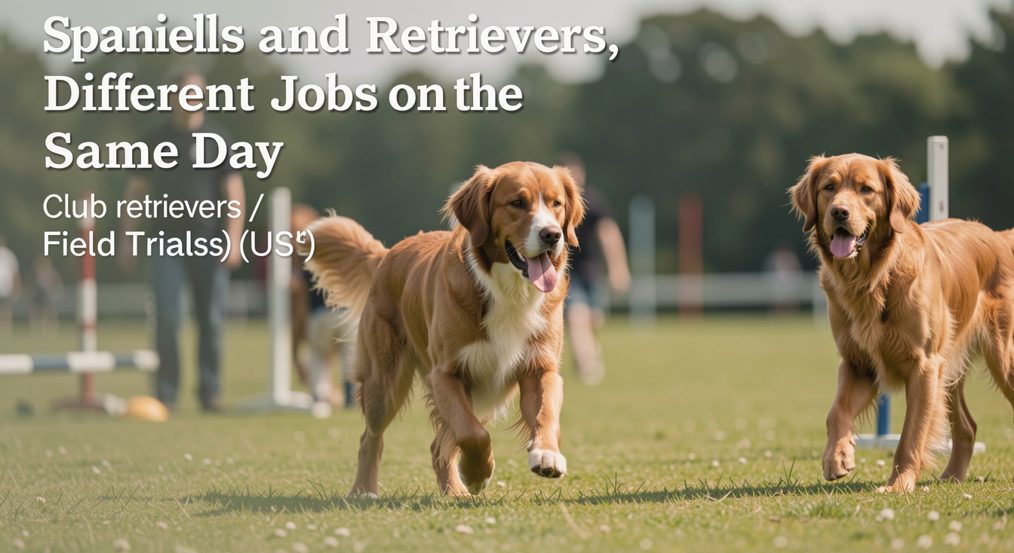
A spaniel finds birds; a retriever brings back birds somebody else found. On a real hunting day both jobs exist, which is why the two kinds of dog have been worked side by side for centuries, and why they were bred to opposite rhythms: the spaniel moving constantly within gun range, the retriever motionless until the shot. Reading the day correctly is the shortest route to understanding both breeds.
What does a spaniel do that a retriever does not?
Quarter, flush and hunt close. A spaniel works a pattern in front of the gun, back and forth through the cover, nose down, and its job is to push birds up within range. The discipline is steadiness within motion: the dog must hunt hard and still stop to the flush and the shot. A retriever's job begins where the spaniel's ends, at the fall, and the two dogs are selected for almost opposite qualities: constant motion against motionless waiting, close ranging against long memory.
The American field separates the two crafts into different sports, but the origin is shared. A retriever's marks and blinds are a ruled copy of what a dog was already doing on the day a spaniel worked ahead of it, which is why the vocabulary crosses over: steadiness, honor, delivery to hand.
Where does each dog stand at the shot?
In a different relationship to the gun entirely. The spaniel at the flush has been hunting for an hour; the shot interrupts its work and asks it to stop in mid stride. The retriever at the blind has been waiting for an hour; the shot starts its work and asks it to watch without moving. The two disciplines look alike in a photograph and are opposites in the dog's head, which is why a retriever trained like a spaniel and a spaniel trained like a retriever are both unhappy dogs.
How did the American Cocker drift from field work toward the show ring?
By being bred for a different judge. The American Cocker Spaniel descends from the same working stock as the English Cocker, but the American show ring selected for coat, head and a compact outline for most of a century, while the field lines of the English Cocker were selected for the work. The result is two dogs with a common ancestor and almost opposite bodies: one bred to be looked at, the other still bred to hunt cover. The AKC's account of the breed records the divergence plainly enough, and the split is the cleanest example in American dogs of what happens when the standard that matters changes.
Can a companion bred Cocker still enjoy spaniel style enrichment?
Yes, as enrichment rather than as work. A companion bred Cocker still carries the nose and the interest, and it can be given quartering games in a yard, retrieves in short grass, scent work and the ordinary pleasures of a dog bred from hunters. What it cannot be asked to do is the day's work of a field bred spaniel: the coat, the structure and the selection are different now. The difference matters because a family that expects the first will be delighted, and a family that expects the second will be disappointed.
| Spaniel | Retriever | |
|---|---|---|
| Position | Quartering ahead of the gun, inside range | At heel or in the blind, waiting |
| Works when | Before the shot, finding and flushing | After the shot, marking and retrieving |
| Bred for | Constant motion, close range, hunt pattern | Stillness, memory, a long delivery to hand |
| At the fall | Stops to the flush and the shot | Watches, waits to be sent |
For readers who want the companion side of that split in full, including the everyday care, the health screening paperwork and how to choose a breeder or a rescue, the desk at American Cocker Spaniel background keeps the breed's reference in one place, from the standard to the living room.
Reading a spaniel's day correctly
- The job is motion inside gun range, not distance work.
- Steadiness means stopping to the flush, not refusing to hunt.
- The American Cocker's drift toward the ring is a breeding fact, not a temperament verdict.
- A companion dog can still be given spaniel shaped work: scent, quartering games, short retrieves.
- What it cannot be asked to do is the field bred dog's day, and asking it is the avoidable error.
Common mistakes
- Assuming a spaniel and a retriever are interchangeable dogs on the same day.
- Judging a companion bred Cocker against a field bred one, or the reverse.
- Reading the show coat as evidence the dog cannot enjoy the work.
- Trying to make the companion dog into a field dog instead of giving it the field shaped enrichment it was built to enjoy.