Trials & Tests
Instinct Days and First Exposures
A first exposure day answers a small question honestly: is there something here to build on. It cannot answer the large question everyone actually brings.
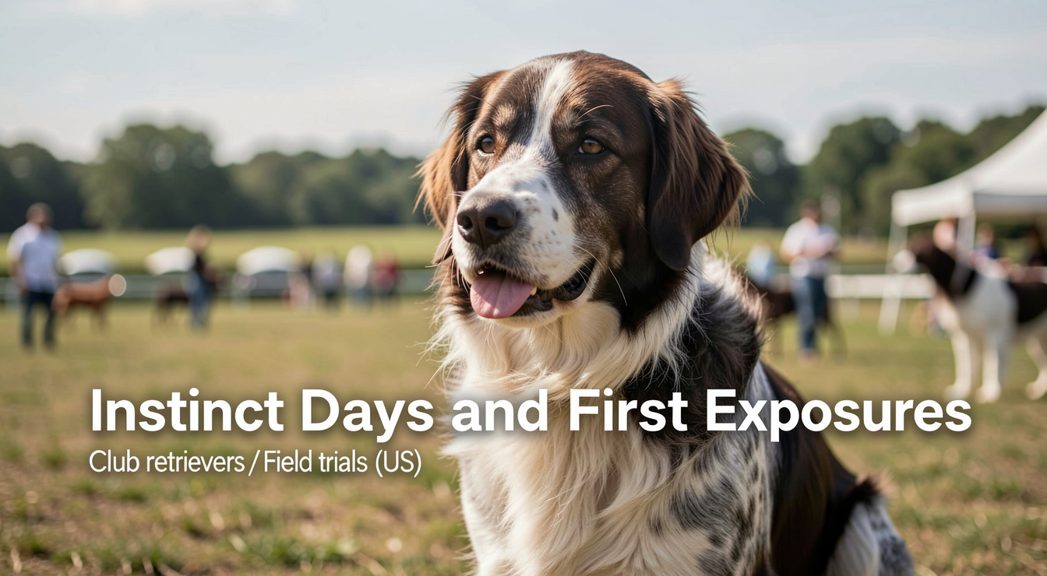
An instinct day tells a handler one thing: whether the raw material is present. A dog that has never seen the game is shown it in a controlled setting, and what the dog does in the first ninety seconds is information about drive and interest. What it is not is a prediction. A first exposure cannot tell whether the dog will mark at two hundred yards, sit steady under pressure or survive a season of being asked.
That distinction, between an aptitude observed and a performance proven, is exactly what the herding world formalized first. The guide at Herding Instinct Test walks a novice through that version of the day: the livestock, the handler's position, the judge's questions, the difference between a certificate of interest and a title of work. The retriever sports have no single equivalent gate, but the same logic applies to every first bird, first water entry and first gunshot.
What is a first exposure actually measuring?
Interest, nerve and recovery, in that order. Interest is whether the dog notices the bird at all: a retriever that watches a clipped pigeon move, tracks it and wants it is showing the raw material the sport is built on. Nerve is whether the dog can be near the new thing without shutting down. Recovery is whether a dog that startles comes back to curiosity quickly, which is the trait that decides how the next ten exposures go.
None of that is a score. A dog that stares at a bird and then goes back to sniffing grass is not disqualified from anything; it is telling the handler where the work starts. The structured version of this reading, the judge watching for the same three things in a herding pen, is what makes the comparison worth making: the test exists to separate instinct from training, so that the trainer knows which of the two is missing.
How should a first bird or a first gunshot be set up?
At a distance, at low intensity, with an exit. First exposures work the same way cold water does: dose, not drama. A first bird is shown, not delivered; a first shot is fired far enough away that it registers as background rather than as an event. The setup that makes a first exposure informative is the one where the dog could walk away, because what it does next is the measurement.
The discipline of that setup is the same one described in cold water work and in the first months: the session ends while the dog still wants more, and the dog's behavior afterward is the data, not the moment itself.
What does a flat first day actually mean?
Usually that the setup was wrong rather than that the dog was. A dog that ignores a bird in a pen may be a dog that was too tired, too full, too far from the bird or too worried about the people watching. The instinct test world knows this and builds a second look into its format, because a single flat day is evidence about the day more often than it is evidence about the dog. The reading that matters is the trend across two or three exposures, each one set up a little differently, and the dog that is still flat on the third good setup is telling the truth.
| Question | Can the day answer it | Why |
|---|---|---|
| Is the dog interested in the game | Yes, usually within the first minute | Interest shows immediately or does not |
| Does the dog recover from a startle | Yes, on the day | Recovery time is observable directly |
| Will the dog mark at distance | No | Marking is trained, and the day does not test it |
| Will the dog hold up under pressure | No | Pressure is a different event entirely |
When does an aptitude become something more?
When it is asked to repeat itself under gradually harder conditions. The herding world's own literature, from the instinct certificate up through the titles listed at the AKC herding program, makes the same progression explicit: the first day certifies interest, the later days certify work. Retriever development runs on the same ladder with different furniture, from the first exposure to the levels described in hunt tests, level by level.
A first exposure done well
- The new thing is shown at low intensity, at a distance, with a way out.
- The session ends early, while the dog is still interested.
- The handler watches recovery, not bravado: a startle followed by curiosity is the good outcome.
- Nothing about the day is treated as a prediction of the finished dog.
- The next exposure is scheduled from what the dog showed, not from the calendar.
Common mistakes
- Reading a strong first reaction as proof of a finished dog. The first day certifies interest, not work.
- Reading a flat first reaction as disqualification. Some dogs need the second look.
- Piling too much into the first day: bird, gun, water and a crowd is four exposures, not one.
- Letting the day's excitement set the next session. The dog's behavior afterward is the data.