Training
Training a Retriever Puppy: The First Months
The first months are about the world, not the bumper. Most of the expensive problems in this sport are made by asking a young dog for something a mature dog should be doing.
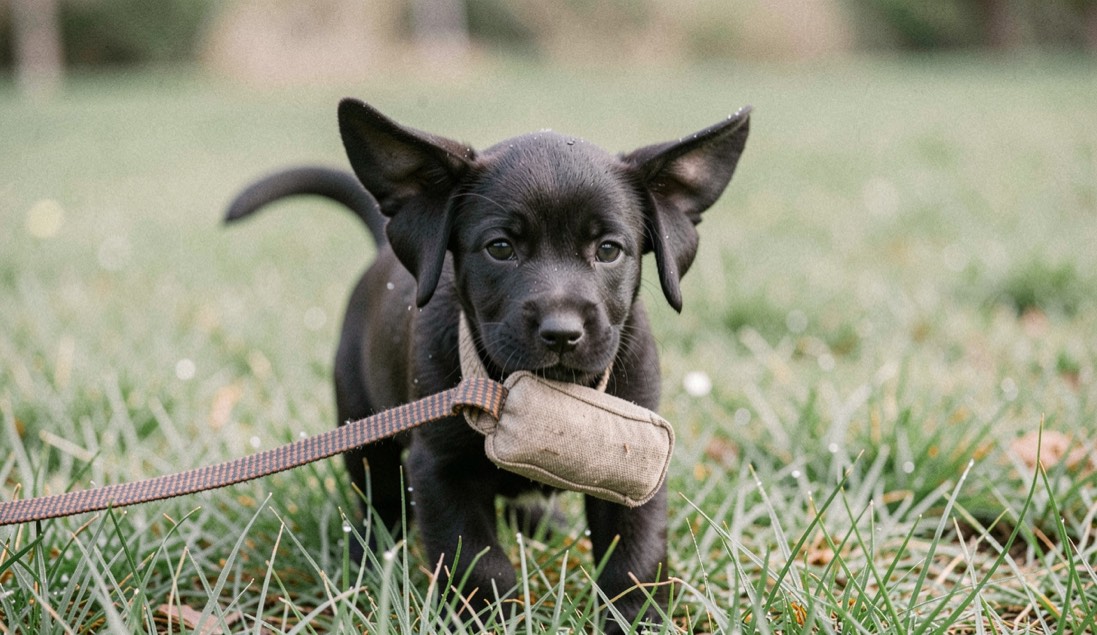
Almost every expensive problem in retriever work is made early, and almost none of them are made by doing too little. They are made by asking a young dog for something a mature dog should be doing, getting it, and then discovering two years later that the dog learned the wrong thing on the way. The first months are not a head start on the training that comes later. They are a different job, and the order matters more than the volume.
The technical target at the far end of the first year is modest and very clear: a dog that watches a single fall, goes to it, brings it back and puts it in the hand, and does that on land and in water without falling apart around other dogs. That is the AKC Junior level, read at the source in the hunting test regulations on September 2, 2026. Everything below is aimed at that and at nothing further.
The first weeks are about the world, not the bumper
A young retriever's first weeks in a new home are spent building a dog that finds the world uninteresting in the right way. Floors that move, stairs, gravel, tall grass, water noise, vehicles, livestock at a distance, other dogs, strangers in hats, the sound of a door slamming in a truck: all of it should become ordinary before any of it becomes a training problem.
This is also when carrying is established, and carrying is not retrieving. A puppy that picks something up and moves toward you with it is doing the only thing that matters at this stage. Nothing is corrected, nothing is taken away roughly, and nothing is repeated until it becomes work. The wish to carry is the one asset that cannot easily be built later, and it is routinely spent in the first month by a handler practicing retrieves.
Two habits are worth avoiding from the first day, because both are expensive to undo in a working dog. The first is teaching the puppy that coming back with something is the moment the fun stops. The second is teaching it that a dropped object gets picked up by a human, which is precisely the reverse of delivery to hand.
Recall, then the whistle sit
A recall that holds under distraction is the foundation of everything, and it is built in the order that everyone knows and few people follow: short distances, high value, no competing interest, then slowly add the world back. A recall that has been ignored twice without consequence is no longer a recall, it is a suggestion, and rebuilding it in an adult dog costs several times what building it cost.
The whistle sit comes next, and it is the single most valuable piece of equipment a working dog carries. One blast, the dog sits and turns to face you. It is built on land, at short distance, in a place with nothing to find, so the sit is about the whistle and not about a bird. Introduced that way, it becomes a reflex; introduced at distance on a real retrieve, it becomes a negotiation the dog will win.
Both of those exist to serve one thing later: the blind, where the dog leaves on a line it did not choose and accepts corrections from a whistle. That relationship is set out in marks and blinds, and it is worth reading early, because knowing what the whistle sit is for changes how patiently it gets built.
Short marks: happy, single, close
Marks for a young dog are short, single and thrown into cover the dog can get through easily. The point is not difficulty. The point is that every single one ends well: the puppy sees the fall, goes straight to it, picks it up and comes back. A young dog that succeeds twenty times in a row is learning that its own eyes are reliable, and that belief is what a mark rests on for the rest of its life.
The puppy bumper is a real consideration and not a detail. It has to be light enough and small enough for a full comfortable grip, because a dog that cannot hold something properly learns to reposition it, and repositioning becomes mouthing. What belongs in the first year and what does not is set out in the puppy supply list.
| Stage | What is being built | What is deliberately not asked |
|---|---|---|
| Arrival and the first weeks | The world becoming ordinary. Crate, car, water noise, footing, other animals at a distance. Carrying, with no corrections. | Formal retrieves, sit at distance, any correction on a returned object. |
| The settling months | Recall under mild distraction. Name, place, waiting for food, walking without hauling. The beginnings of a sit on command. | The whistle at distance, doubles, cover the dog cannot handle. |
| Mid first year | Whistle sit on land at short distance. Short happy singles on land. First shallow water entries in warm weather. | Blinds, casting, marks over water it has not entered voluntarily. |
| Late first year | Singles at greater distance on varied ground. Delivery to hand every time. Sitting quietly while another dog works. | Multiple marks, gunfire close in, cold water, pressure of any kind on a young dog. |
| The turn into the second year | Steadiness through a throw. Marking on ground the dog does not know. Working near activity without unraveling. | Blind work as a program, three fall memory, any level above the entry level. |
Water and noise, introduced not imposed
The first entry into water decides ten years of the dog's relationship with it. It is done in warm weather, in shallow water with a gently shelving entry the dog can walk into, and it is done because the dog wants to follow something, not because it is sent. A puppy that walks in on its own, swims two strokes and comes out is a complete success. A puppy that is carried in and dropped has been taught something that will surface later, in November, at the worst possible moment.
Cold is a separate subject from water, and it belongs to a later stage of the dog's life. No thresholds appear on this page, because none has been read at the source here; what is published on that question is the principle that exposure is a dose rather than a temperature, and it is set out with the observable warning signs in cold water work. Anything that becomes a medical question goes to a veterinarian rather than to a web page.
Noise is introduced the same way, which is to say at a distance where nothing happens. Gunfire in this sport is not a subject in its own right; it is a sound the dog learns to treat as ordinary, and it is associated with something good arriving at a distance far enough away that the puppy barely notices it. Then the distance closes, over weeks, and it closes only while the dog remains uninterested. A dog made noise sensitive by one bad introduction is a long and uncertain repair.
The first year, stage by stage
- Arrival: crate, car, footing, water noise at a distance, and carrying without any correction whatsoever.
- Settling: recall built short and then extended, name and place, a sit that means sit while you are standing next to it.
- Mid year: whistle sit on land with nothing to find, short happy singles, first voluntary entries into warm shallow water.
- Late year: delivery to hand on every retrieve, singles on unfamiliar ground, sitting quietly while another dog works.
- Year end: steadiness through the throw, with a lead present as a backstop rather than as a brake.
- Throughout: end every session while the dog still wants more, and never on a failure you then repeat to fix.
- Throughout: no pressure, no repetition to the point of boredom, and no exercise whose only purpose is to look impressive.
What can wait until the second year
Blind work can wait. Casting can wait. Multiple marks can wait. Cold water can wait, and should. Honoring, walk ups, diversions and anything that belongs to the levels above the entry level can all wait, because they are asked of dogs that have already proved they can mark and deliver, and asking earlier does not accelerate anything.
What cannot wait is the delivery, the recall and the whistle sit, because those three are habits rather than skills, and habits harden. A dog that arrives at its second year with those three genuinely solid can be brought to an entry level test inside a season. A dog that arrives with a beautiful mark and a negotiable recall will spend that season on repairs instead. Choosing where that season points is the subject of which program to start with, and the vocabulary it all runs on is defined in the glossary of the line.
Common mistakes
- Practicing retrieves in the first weeks. The wish to carry is the asset, and repetition is the fastest way to spend it.
- Taking the object out of the puppy's mouth firmly. That is how a dog learns to drop early, and delivery to hand is required from the lowest level upward.
- Letting a recall be ignored. Twice is enough to turn a command into a suggestion, and rebuilding it later costs far more.
- Introducing the whistle sit on a real retrieve. The dog will weigh the whistle against the bird, and the bird wins.
- Forcing the first water entry. One carried and dropped puppy can produce a dog that runs the bank for years.
- Bringing gunfire in close too early. Noise sensitivity is easy to create in one session and slow to undo.
- Treating a stage list as a schedule. Dogs mature at their own pace, and the order below is a sequence rather than a set of ages.