Training
Marks and Blinds: The Two Retrieves
A mark is memory. A blind is trust. Those are two different jobs for the dog and two different jobs for the handler, and the whole ladder is built by adding one to the other.
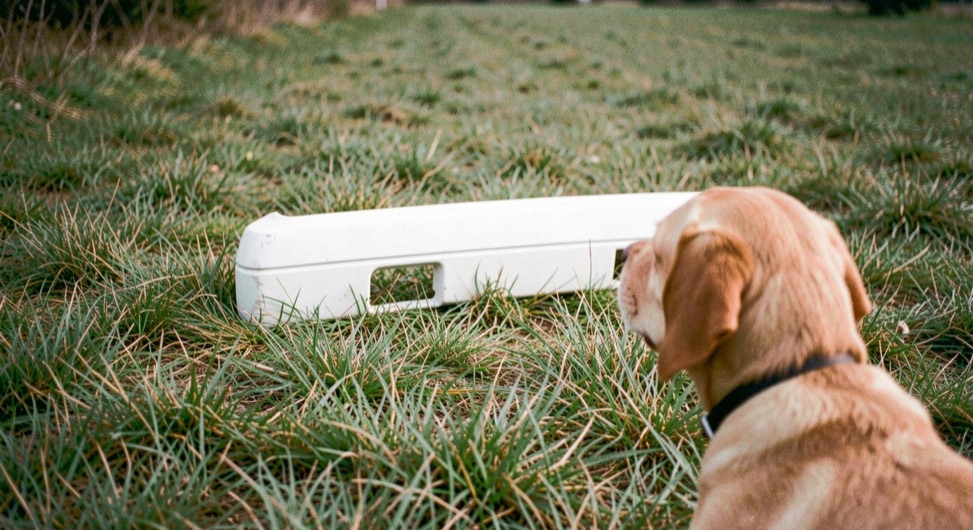
The two words in this publication's name are also the two halves of the sport. A mark is a bird the dog watched fall and now has to remember. A blind is a bird it never saw, which it can only reach by taking a direction from the handler, stopping to a whistle and accepting casts. One is memory, the other is trust, and a dog can be genuinely excellent at one while being useless at the other.
Everything organized retriever work asks for is built by adding those two jobs together in a fixed order. Understanding which one a level is testing, and what it costs the dog, is the difference between training with a destination and training by accumulating drills.
A mark is memory, a blind is trust
On a mark, the dog is the one who knows where the bird is. It saw the fall, it holds a picture of it, and its job is to convert that picture into a straight line and then into a short honest hunt at the end. The handler's job on a mark is almost entirely negative: line the dog up fairly, send it, and then stay out of the way. Every whistle blown on a mark is an admission that the picture was not good enough.
On a blind, the situation reverses completely. The dog has no information at all. It has never seen the bird, it does not know the distance, and it has no reason to believe there is anything out there. What it has is the handler, and the entire retrieve rests on the dog being willing to leave on a line it did not choose, keep going through cover it cannot see into, stop when a whistle says stop, and change direction on a signal that contradicts what it was doing. That is not obedience in the ordinary sense. It is a dog agreeing to be wrong about where the bird is.
The training consequence follows directly. A mark is improved by giving the dog better information and more chances to be right on its own. A blind is improved by making the handler's information reliable enough to be worth accepting. Confusing the two produces the two classic broken dogs of this sport: the dog that looks back for help on marks, and the dog that ignores the whistle on blinds because it has learned it is usually right.
| Mark | Blind | |
|---|---|---|
| What the dog knows | Where the bird fell, from having watched it. | Nothing. It has no evidence a bird exists. |
| What the dog uses | Memory, and its own judgment of distance and angle. | The line it was given, the whistle, and the casts. |
| What the handler does | Lines the dog up fairly and then stays quiet. | Chooses the line, stops the dog, and changes its direction. |
| What a whistle means | Something went wrong with the picture. | Normal operation. The blind is run on whistles. |
| What failure looks like | A wide hunt, a switch to another bird, or a return without the bird. | Refusing a cast, popping for help, or drifting off the corrected line. |
| What it costs to train | Repetition on varied ground, and restraint from the handler. | Control at distance, built slowly, and a handler whose information is worth taking. |
| Where it first appears | AKC Junior: at least four single marks, two on land and two on water. | AKC Senior: a land blind and a water blind, which may be run as one double blind. |
Singles, doubles and the memory bird
Marks are counted by how many falls the dog has to hold before it is sent. One fall is a single, and the AKC Junior level is built on them: the regulations require at least four single marks, two on land and two on water, with no more than two marks thrown in any one series. Nothing is asked of the dog except to watch, remember one thing, go, and deliver to hand.
Two falls make a double, and the difficulty is not distance but order. The last bird down is normally the one the dog is sent for first, and the other one has to survive in memory while the dog works, returns and delivers. That surviving bird is the memory bird, and it is where doubles are actually won and lost. The AKC Senior level asks for a double on land and a double on water inside at least four hunting situations.
Three falls is where the demand becomes structural rather than incremental. The AKC Master level requires that in at least two multiple mark situations the dog remembers three falls before it is sent for the first one. Everything that separates a strong Senior dog from a Master dog tends to live in that requirement, because holding three pictures while executing on one is a different mental act from holding one.
The blind: line, whistle sit and casts
A blind has three moving parts and they fail in a predictable order. The first is the line: the handler sets the dog's body and head on a direction and sends it. A blind that starts badly rarely recovers cheaply, because every correction afterwards costs a whistle and a cast, and each one is another chance for the dog to disagree.
The second is the whistle sit. One blast, the dog stops and turns to face the handler. Stopping and turning are one action, not two: a dog that stops without turning has not answered, and a dog that turns while still drifting has answered late. This is the single most useful thing in the whole apparatus, because without it there is no way to correct anything at distance.
The third is the cast. An arm and a body signal that sends the dog in a new direction, which is normally not the direction it wanted. A cast refusal is a dog that takes a different line, or none at all, and it includes the dog that appears to take the cast and then curves quietly back onto its original idea. That last version is the one handlers miss, because it looks like compliance for the first few strides.
The order the two are built in
- Marks first, long before blinds. A dog that cannot mark has nothing to be corrected away from.
- Delivery to hand before anything else is added, because it is required from the lowest level upward.
- The whistle sit built on land, at short distance, in a place with nothing to find, so the sit is not about a bird.
- Casts introduced with the bird already known to the dog, then gradually with the dog knowing less.
- Doubles only once singles are honest at distance and the dog stops hunting the area it likes.
- Blinds and multiples kept apart in training until the level being prepared for actually mixes them.
Where each level asks for which
The AKC hunting test ladder adds the two in a clean order, which is why it reads as a progression. Junior is marks only, in singles. Senior adds the blinds, the honor and the walk up, and it keeps them separate: in Senior, the blinds are not run between the marks. Master keeps everything and mixes it, adding multiple marks on land, on water and combining both, at least one double blind, a mandatory honor and the three fall memory requirement.
That single detail about Senior deserves attention from anyone training toward Master. Because Senior does not run blinds between marks, a dog can pass Senior without ever having to switch mode in the middle of a marking sequence. Master will ask for exactly that, and the switch of mode is the thing to rehearse before entering, not more of either retrieve on its own. The full requirements level by level are set out in hunt tests, level by level, and the other three programs sit beside them in the stakes and levels table.
The faults that live between the two
The most interesting faults in this sport are not failures of ability. They are the dog resolving the contradiction between memory and trust in the wrong direction, and each of them has a name that contains its diagnosis.
Popping is a dog stopping on the way out and looking back for help nobody offered. It is a mark fault dressed as obedience: the dog has learned that the handler will supply an answer, so it stops supplying its own. Blinking is the opposite in feel and worse in consequence: the dog finds the bird, or gets close to it, and leaves. And switching is the one with a written consequence, read at the source in the AKC hunting test regulations: a dog that gives up on one bird and goes to another is scored zero in perseverance, and that ends the qualification in Senior and in Master.
Common mistakes
- Handling on marks because it works. Every whistle on a mark teaches the dog that its own picture is optional, and that is how popping is built.
- Starting blinds too early. A dog that has not yet learned to be right on its own has nothing to trade for trusting the handler.
- Treating a cast refusal as disobedience. More often it is a dog that has been right too many times and has no reason to believe the new direction.
- Confusing popping with blinking. One is about the line out, the other is about the bird itself, and they are corrected in opposite ways.
- Training doubles for distance rather than for the memory bird. The second fall is the test, and it is usually failed at a comfortable distance.
- Quoting a distance as a requirement. No level on this site is described by a distance, because distances are set on the day from the ground and the wind available.
Every term used above has its full entry in the glossary of the line. What a young dog should be doing before any of this begins is set out in the first months, and the equipment that lets one person set a double at real distance is covered in bumpers and launchers.