Grounds
Getting a Working Animal to a Public Event Day
The day a working animal goes to a public event is decided the night before: the weather on the actual ground, the access in writing, the limits of comfort fixed while the decision is still calm.
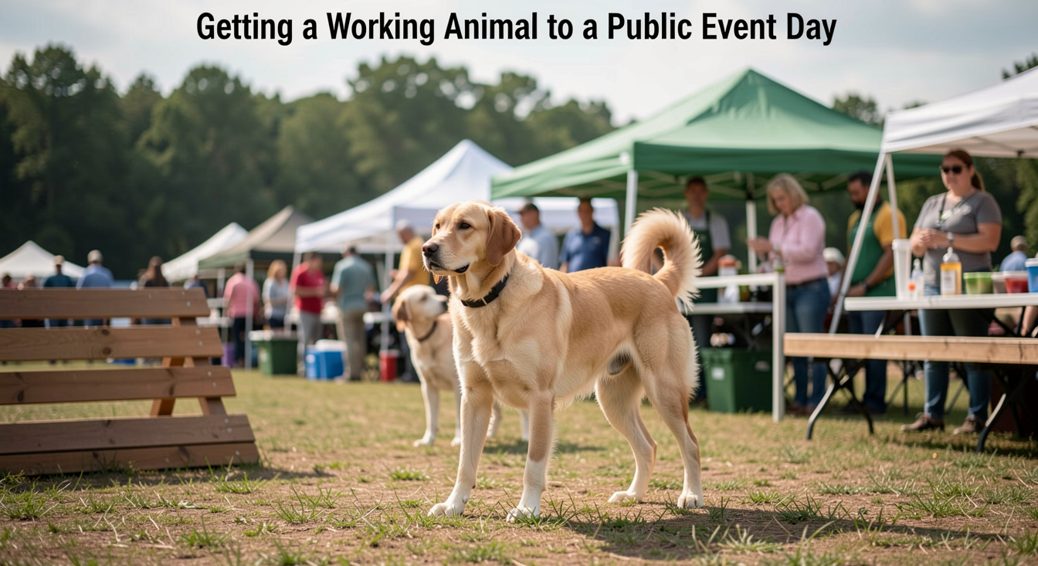
A public event day for a working animal is made or lost the night before. The decisions that matter are the ones taken while they are still calm: the weather read on the actual site rather than on the county, the access confirmed in writing rather than assumed, the limits of the animal's comfort fixed in advance so that the day's judgment is never the first time the question was asked. The animal does not get to vote; the handler's preparation is the vote it gets.
What should be decided the night before?
The weather, the access and the exit. The weather means the forecast for the ground itself, because a fairground in a valley and a farm on the hill above it are different mornings. The access means the gate, the unloading point and the time confirmed in writing, because a public event day has its own schedule and the animal's part of it is the part that cannot be improvised. The exit means the moment the animal leaves, decided in advance, so that the day has a planned end rather than a negotiated one.
The same decisions get asked of every working animal that goes out in public. The draft horse world has the identical problem, and horses at public events covers it as a complete guide: the preparation, the welfare limits and the judgment call that the day sometimes demands. The agricultural fair circuit it belongs to runs on the same calendar, and a New England example is the Eastern States Exposition.
How do you set welfare limits in advance?
By writing them down while the day is still hypothetical. The temperature above which the animal does not work, the length of time it can be asked to hold, the sign that means the day is over: all of them fixed in advance, because the person making the call on the day is never as objective as the person who made it the night before. The working dog version of the same discipline is the dose logic in cold water work: the limit is set before the exposure, not during it.
What does the animal say on the day?
The truth the preparation tried to anticipate. A horse that will not settle in the trailer, a dog that is flat before the first class, an animal that is simply off: the day tells the handler what the forecast could not. The limits set the night before are the frame for that reading, because an animal that is merely excited and an animal that is not right look similar from inside the day and very different through the written thresholds.
When is staying home the right call?
When the conditions the night before say so, and when the animal says so on the day. The decision not to go is a legitimate outcome of the preparation, not a failure of it. A forecast that breaks the temperature limit, an access that could not be confirmed, an animal that is off in the morning: any of those is the preparation working, and the day that is declined is cheaper than the day that should have been.
| Decision | Made on | What it prevents |
|---|---|---|
| Go or stay | The forecast for the actual ground | A day that should not have happened |
| Access and unloading | Writing, confirmed | A trailer that cannot get where it needs to be |
| Comfort limits | The animal's known thresholds, written down | A judgment made in the moment by a tired person |
| Exit time | The schedule, in advance | A day that runs long because no one planned its end |
The public event day is also where the club's ordinary habits get tested in front of an audience, which is one more reason the night before matters. A dog that holds its manners at a crowded gate is the club's quietest advertisement.
The night before a public day
- Forecast read for the site itself, not for the county.
- Access and unloading confirmed in writing, with a time.
- The comfort limits written down: the temperature, the duration, the sign that ends it.
- The exit decided, so the day has a planned end.
- The option of staying home held open as a real answer, not a failure.
Common mistakes
- Reading the county forecast for a valley fairground.
- Assuming the access rather than confirming it in writing.
- Setting the welfare limits on the day, by the person least objective about them.
- Treating the decision to stay home as a defeat instead of as the preparation working.