Grounds & Seasons · Grounds
What Makes Good Retriever Training Ground
Water first, everything else after. And access last on the list only because it is the criterion that eliminates half the candidates once you finally ask about it.
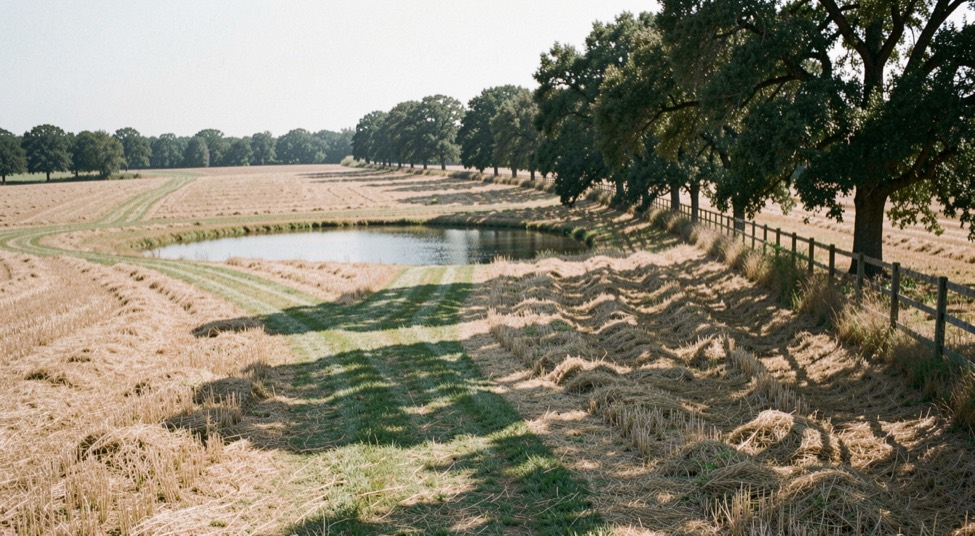
In the Northeast the limiting factor on retriever training is almost never the dog and almost never the handler. It is ground. Whether there is water that is open, deep enough and legal to use. Whether there is cover that hides a bumper honestly instead of swallowing it. Whether the field is long enough to matter. And, last on the list and first in practice, whether anyone is actually allowed to be there.
What follows is a grid for judging a field in one visit instead of discovering it over three failed sessions. No real ground is named here, no owner and no address: this page describes criteria, not a directory.
Water first, everything else after
Water is the criterion that cannot be substituted. A field with no usable water is a field where an entire half of the sport cannot be trained, and no amount of equipment fixes that. The upper levels of every program require water retrieves: the AKC hunting test regulations, read at the source on September 2, 2026, require a double mark on water and a water blind at Senior, and multiple marks on water at Master. A dog cannot be prepared for those on dry land.
What makes water usable is more specific than its presence. It needs an entry the dog can take at speed without a drop, because a raised bank teaches hesitation and hesitation becomes a habit. It needs depth enough to require swimming rather than wading, since a dog that can touch bottom is doing something else. It needs an exit that is not the same as the entry, ideally more than one, so a returning dog with something in its mouth is never solving a problem. And it needs a shape that allows a line across it rather than only along it, because the temptation to run the bank is created by geometry more than by character.
The last consideration is seasonal. Water that is perfect in June may be a mud flat in August or unreachable in April, and a field is only as useful as the months it is actually usable in. That question is treated across the year in how a trial year is built.
Cover: what hides a bumper honestly
Cover has one job in training: to hide the object without making it unfindable. Ground with no cover at all produces a dog that never has to hunt, which is pleasant and teaches nothing. Cover that is too heavy produces a dog that gives up or, worse, learns that the handler will eventually come and help, which is the reflex that builds popping.
The useful test is simple. Walk out and drop a bumper where you intend to throw one, then walk back to the line and look. If you can see it, the mark is not testing marking. If the dog will need help to find it, the mark is testing the wrong thing. Between those two is the range that teaches, and it changes every few weeks through the growing season on exactly the same field.
Variety matters as much as quality. A field that offers only one kind of cover produces a dog that is excellent in that kind and lost in another, and the ground on a test day is never the ground you trained on. Edges, transitions between cover types and changes of footing are the parts of a field that make a dog think.
Distance, terrain and the ground that falls away
Length is worth having and it is not the first thing to look for. What matters more is what happens along the way: whether the ground rises or falls, whether there is a ditch, a hedge, a change of footing or a strip of different cover for the dog to cross. A short mark with two transitions in it teaches more than a long flat one.
Terrain that falls away from the line is particularly valuable and particularly rare, because a dog running downhill and out of sight has to hold its own picture without the handler's ground being visible the whole way. Ground that rises has the opposite effect and makes everything look closer than it is, which is useful for a different reason.
No distance figure appears anywhere on this site, including here and including as an observed habit, because in the discipline the distances are set on the day by the people judging, from the land and the water available. What a field should offer is not a number, it is the ability to set the same test twice and to lengthen it as the dog improves.
| Criterion | What to look for | What quietly rules the field out |
|---|---|---|
| Water | An entry the dog can take at speed, depth that requires swimming, an exit that is not the entry, and a shape that allows a line across. | No water at all, a raised or steep bank, or water that disappears for part of the usable year. |
| Cover | Enough to hide the object from the line, light enough that a dog can find it without help. Several types, with transitions. | Nothing to hide a bumper, or cover so heavy that every mark becomes a rescue. |
| Terrain | Changes along the way: a rise, a fall, a ditch, a change of footing, a strip of different cover. | Flat, uniform ground where every mark is the same mark at a different length. |
| Length | Room to lengthen a mark as the dog improves, and room to move the line rather than always working from one spot. | A field whose only setup is its maximum, so nothing can grow. |
| Wind and sun | Enough room to set up in more than one direction, so the wind can be used or worked against on purpose. | A single possible line, which means the dog always meets the same conditions. |
| Access | A named person who has agreed, a way in that does not damage anything, and parking that is not in the way. | Nobody asked. That is not training ground, whatever else it offers. |
| Hazards | Known and checked: wire, roads, livestock, machinery, and anything in the water. | Any of the above unresolved, or unknown because nobody walked it. |
Wind, sun and the direction you set up
Wind decides more of a mark than distance does. A crosswind moves scent off the fall and turns a fair mark into a hunt on the downwind side; a headwind makes the same fall easy; a following wind pushes the dog past it. None of those is better than the others, and a field where you can only ever set up one way means the dog only ever meets one of them.
The sun matters for the same reason and is easier to forget. A dog looking into low sun cannot mark what a handler can see perfectly, and a field that is only usable at the end of the day will present that problem constantly. The ability to move the line, even by a small amount, is worth more than another hundred paces of length.
Walking a field for the first time
- Walk it before you send a dog into it, all of it, including the water margins and anywhere a dog might exit.
- Look for wire, old fencing, machinery, and anything submerged near an entry or an exit.
- Drop a bumper where you would throw one, walk back to the line, and see whether you can see it.
- Check that there is more than one exit from the water, and that a tired dog carrying something can use them.
- Stand in at least two possible lines and notice what the wind and the sun do from each.
- Ask who owns it and what the land is used for in the other seasons before you ask whether you can train there.
- Read the state's own rules on training dogs outside the hunting season before doing anything with birds.
Access, permission and the rules that come with it
The criterion that decides most cases is the one that has nothing to do with the field. A field with perfect water and honest cover that nobody has asked about is not training ground; it is trespass with a dog in it. Asking properly means knowing who owns it, what the land is used for the rest of the year, and what a truck and a dog actually cost the owner in ruts, disturbance and gates left open.
Ground that is kept for years is almost always ground where somebody handled that conversation well at the beginning and then kept handling it: turning up when they said they would, leaving no trace, and being easy to say yes to a second time. That is a relationship rather than a permission.
The separate legal question is what a state allows in the way of dog training outside the hunting season, particularly where birds are involved. Those rules are set and published by the state agency, they are a different document from the season rules, and they are read there rather than inferred from what people do. The structure that produces both is described in how seasons are set. What equipment can and cannot compensate for on a given field is covered in bumpers and launchers, and what the water itself costs the dog in the cold months is in cold water work.
Common mistakes
- Judging a field from the road. The water margins and the exits decide most of it, and neither is visible from a gate.
- Choosing length over variety. A short field with transitions teaches more than a long flat one.
- Ignoring the wind at the setup stage, then blaming the dog for the hunt it produced.
- Training in one direction because it is convenient. The dog then meets one wind and one light, forever.
- Assuming water is water. Entry, depth, exit and shape are four separate questions.
- Believing equipment can fix a ground problem. A launcher lengthens a mark; it does not create water.
- Skipping the access conversation. It is the criterion that eliminates half the candidate fields, and the only one that can end badly.